
BB fertilizer (Bulk Blend fertilizer) is a type of physically blended granular fertilizer. Thanks to its flexible formulations, high production efficiency, and broad applicability, it is widely used in various agricultural settings. Unlike chemically synthesized fertilizers, BB fertilizer relies entirely on the precise proportioning and uniform mixing of raw materials without the aid of chemical reactions; therefore, product quality depends entirely on meticulous process control.
The selection and compatibility of raw materials are the primary focus of BB fertilizer production process. Before production, strict controls must be applied to the particle size, hardness, moisture content, and flowability of the granular raw materials, ensuring that the specifications of different materials are as similar as possible. Significant disparities in particle size or density can easily lead to material segregation during subsequent mixing, conveying, and packaging, resulting in localized nutrient imbalances. Additionally, raw materials that are damp, clumped, or deteriorated must be discarded to prevent issues such as uneven mixing, clumping of the finished product, and unstable fertilizer efficacy, thereby ensuring basic product quality at the source.
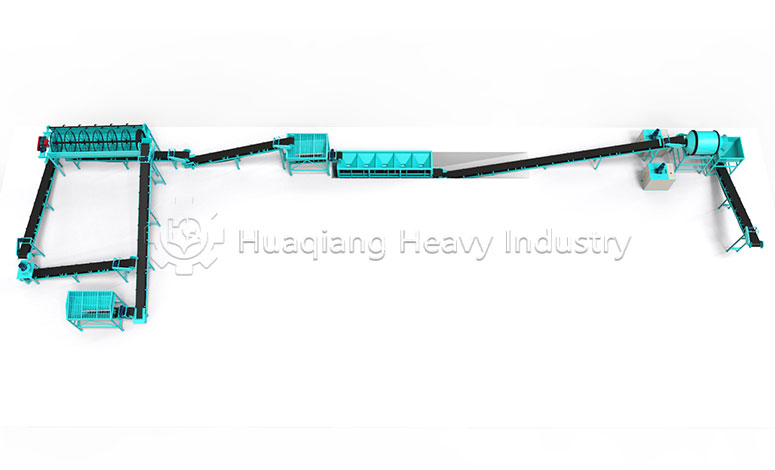
Precise proportioning and uniform mixing are the core control points of production. The main advantage of BB fertilizer lies in its customizable nutrient formulations; thus, raw materials must be measured precisely according to the formula ratios, eliminating errors associated with manual estimation. Equipment mixing time and rotation speed must also be carefully controlled. Insufficient mixing leads to uneven blending, while excessive mixing can cause particle abrasion and increased dust generation, compromising the fertilizer's physical properties and affecting its subsequent application performance.
Post-production storage, transportation, and environmental control cannot be overlooked. Production workshops must be kept dry and well-ventilated to prevent granules from absorbing moisture and clumping. During the discharge, conveying, and packaging of the finished product, drops and vibrations should be minimized to reduce the risk of nutrient segregation. Once packaged, products should be stored by category and protected from heavy stacking pressure; batch labeling is also essential to facilitate quality traceability. Only through strict, detailed control across the entire process can high-quality BB fertilizer with balanced nutrients and stable physical properties be consistently produced.